

Open Google on your phone, stand in your own waiting room and search “doctor near me.” Look at the three practices in the pack.
They aren’t there by accident, and they aren’t hiding anything. Every field that put them there is public. That makes them the best free audit you will ever get. You don’t have to guess which of Google’s signals your listing is missing, because you can read the answer off the three listings that beat you.
I run Local SEO for medical practices, and this teardown is the first thing I do on every account. It takes an afternoon. It ends with a ranked list of gaps, cheapest to fix first. Along the way it also settles the question most owners ask first: why “doctor near me” behaves differently from a search for a specialty.
Which Nine Fields Do You Pull From the Three Practices in Your Pack?
The nine fields are the primary category, the other categories, the services list, the review count, the review score, the date of the newest reviews, the photos, the website page the profile links to and the address type. Those fields cover what Google says it uses to rank local results: relevance, distance and prominence. They go in one sheet, with your own listing in the first column.
Google’s local ranking page defines the three signals, and it adds that no one can request or pay for a better local ranking. So the sheet is the whole job: no hidden lever exists.
| Field | Where it shows | Signal it feeds | Your listing | Pack 1 | Pack 2 | Pack 3 |
|---|---|---|---|---|---|---|
| Primary category | Line under the name in Maps | Relevance | ||||
| Other categories | The listing’s “About” details | Relevance | ||||
| Services | The profile’s services list | Relevance | ||||
| Review count | Beside the star rating | Prominence | ||||
| Review score | Star rating | Prominence | ||||
| Newest reviews | Sorted by newest | Prominence | ||||
| Photos | Photos tab | Relevance and trust | ||||
| Website page | The link on the profile | Relevance | ||||
| Address type | Street view and the map pin | Distance |
Whitespark’s 2026 expert survey, summarized by gmbapi, ranks the primary category first among local pack factors and proximity second. It’s a survey of expert opinion, not a statement from Google, and the sheet tests it against your own market.
Why Does Searching “Doctor” Give Different Results From a Specialty?
A generic query gives Google no specialty to match, so the profile’s primary category and its distance carry most of the decision. That is why a practice can sit in the pack for “cardiologist near me” and vanish for “doctor near me.”
I run both searches and read the category line under each name in the pack. Comparing the two packs shows which categories Google matches for each query: the broad search pulls whatever category the profiles carry, and the specialty search pulls profiles that carry the specialty’s own category. Google’s guidelines tell owners to choose the fewest categories that describe what the business is, as specifically as possible, so a heart practice that lists a generic category competes in the wrong pack.
| Practice | Primary category to look for in the editor |
|---|---|
| Family medicine | Family practice physician |
| Children’s care | Pediatrician |
| Heart care | Cardiologist |
| Bone and joint | Orthopedic surgeon |
| Skin care | Dermatologist |
Category names change, so I pick from the live list in the editor and never from a blog post. One trap deserves a warning. Experts rate keywords in the business name as a strong factor, and Google’s guidelines ban extra descriptors in the name and warn that doing so can lead to suspension. Competitors in your pack that carry keywords in their names are taking a risk, and copying them transfers that risk to you.
What Do the Review Columns Tell You?
They tell you the size of the prominence gap and how fast it’s closing. Count, score and the dates of the newest reviews each answer a different question: how far behind you are, how good the experience reads and whether the competitor is still collecting reviews.
A quick calculation turns the columns into a number. Take the pack leader’s review count, subtract yours and divide by the reviews you collect per month. The result is the months of steady collecting you need just to match the count, assuming the leader stands still, which a leader who keeps collecting won’t. A leader whose newest review is months old is a different target than one who gets a review every week.
Reviews in healthcare carry privacy rules that retail reviews don’t, both when you ask and when you reply. The HIPAA review guide covers both, and I never compare review columns without reading it first.
Which Gap Is Cheapest to Close First?
The one at the top of the time-to-fix ladder: category and services take an hour, photos and hours a day, the website page match days to weeks, reviews and links months, and distance can’t change at all.
| Gap you found | Time to fix | Who controls it |
|---|---|---|
| Wrong primary category or thin services list | An hour | You |
| Missing hours, photos, attributes | A day | You |
| Profile links to a page that doesn’t match | Days to weeks | You and your web team |
| Fewer reviews than the pack | Months | Patients, through an honest process |
| Fewer links and listings | Months | Partly you |
| Your address is farther from the searcher | Not fixable | Nobody |
I start at the top because fast fixes also test a theory: if a category change moves the grid inside a month, the relevance diagnosis was right. Slow gaps start in parallel and pay off later.
What If the Pack Leader Is Simply Closer?
Closer doesn’t guarantee the win, and Google says so directly: its systems can rank a farther business higher when it looks more likely to have what the searcher wants. When distance is the gap, the answer is to win on relevance and prominence.
That means a sharper category, a complete services list, a location page that matches the profile and a review base that keeps growing. A second location helps only when it’s real: its own street address, permanent signage and its own staff. A virtual office isn’t eligible for a profile, and a P.O. box isn’t an address Google accepts.
How Do You Check Progress From Outside Your Own Building?
With a grid scan, because the pack changes with the searcher’s location and a single rank check lies. A geo-grid tracker searches the same term from dozens of points around the clinic and colors each point by position.
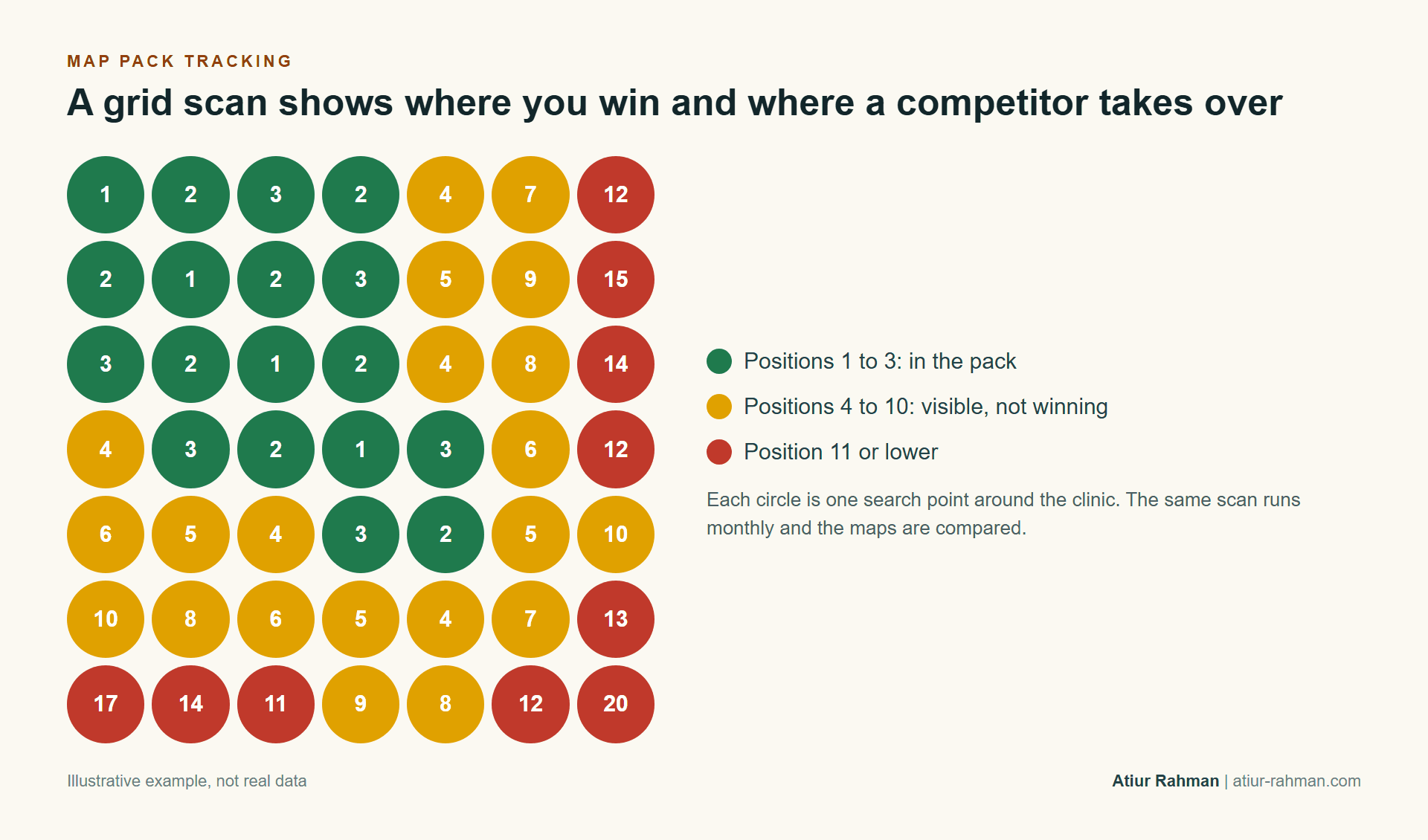
I run the same scan monthly and compare maps, not single numbers. The map shows which blocks you win and where a competitor takes over, which is the distance and relevance story in one picture. Alongside it I track the actions patients take from the profile, and a tagged website link (UTM parameters on the profile’s URL) separates profile visits from other organic traffic in analytics. No patient details enter any tag or URL.
Frequently Asked Questions
How long does it take to reach the Map Pack?
Google publishes no timeline, so nobody can honestly promise a date. Profile corrections take effect once Google processes them, and reputation builds one review at a time. I judge progress on the grid month over month.
Can I rank in a city where I have no office?
No. Google requires a real, staffed address with signage, and virtual offices aren’t eligible. A practice earns pack visibility in the city where its door is.
Does each doctor need a separate Google profile?
A public-facing doctor reachable at the verified address during stated hours is eligible for a practitioner profile, alongside the practice profile. Support staff aren’t. The profile setup guide covers the rules.
Does running Google Ads help my Map Pack ranking?
No. Google says there is no way to request or pay for a better local ranking. Ads and the pack are separate placements with separate plans.
Do keywords in my business name help me rank?
Experts rate them as a strong factor, and Google’s guidelines forbid adding descriptors to the name. A suspended profile costs far more than the keyword earns, so the real-world name stays.
Want your practice in the top three? Book a strategy call.
References
- Google Business Profile Help, Local ranking tips
- Google Business Profile Help, Business Profile guidelines
- Whitespark, Ranking Factors 2026
- gmbapi, 2023 vs 2026 comparison
- Schema.org, MedicalClinic and Physician