

A practice that opened last week has a name, an address and a license. To Google, that is not a practice yet. It is a claim.
Google can’t walk into your building. It confirms a practice the way a credentialing office does: by matching your claims against sources it already trusts. Does the address exist? Is the license real? Do the doctors appear anywhere except your own site? Does anyone outside the practice say it exists?
Until those facts line up, a new practice stays invisible, however good the website looks. The facts are finite, though, and the order in which Google confirms them is predictable. This guide lays them out as a ledger, shows which one blocks the rest and tells you what to do first. I run Local SEO for medical practices, and this is the order I use for every opening.
What Does Google Actually Know About a Practice That Opened Last Week?
Almost nothing it trusts. Google knows only what you tell it until an independent source confirms it. A new practice needs five facts confirmed: that it exists, where it sits, who works there, what patients can book and what other people say about it. Each fact is confirmed in one main place, and some of those places have to be ready before the doors open.
| Fact Google needs | Where it gets confirmed | Do you control it? | Ready before opening? |
|---|---|---|---|
| The practice exists | A verified Business Profile, backed by permanent signage at the address | Yes | Yes, once signage is up |
| The address is real | The map pin, the signage and Google’s address rules (no P.O. boxes, no virtual offices) | Yes | Yes |
| The doctors are real | Public records such as the NPI registry and state licensing lookups, practitioner profiles, provider pages on your site | Partly | Yes |
| What patients can book | Location, service and provider pages on your site, plus services, hours and the booking link on the profile | Yes | Yes, if the site goes live early |
| What others say | Patient reviews and directory listings | No | No. It starts with the first patients |
Read the last column first. Four of the five facts are ready before you see a patient. A practice that waits until opening week to start has pushed four confirmations into the slowest part of the schedule. The rules behind each row sit in Google’s business profile guidelines, which is the document I check before touching any new listing.
Which Fact Blocks All the Others?
The verified address blocks everything, because verification is what tells Google you’re authorized to represent the business, and Google’s guidelines require permanent, fixed signage with your business name at that address. Signage is the first real deadline on a new practice’s calendar, and most owners schedule it last.
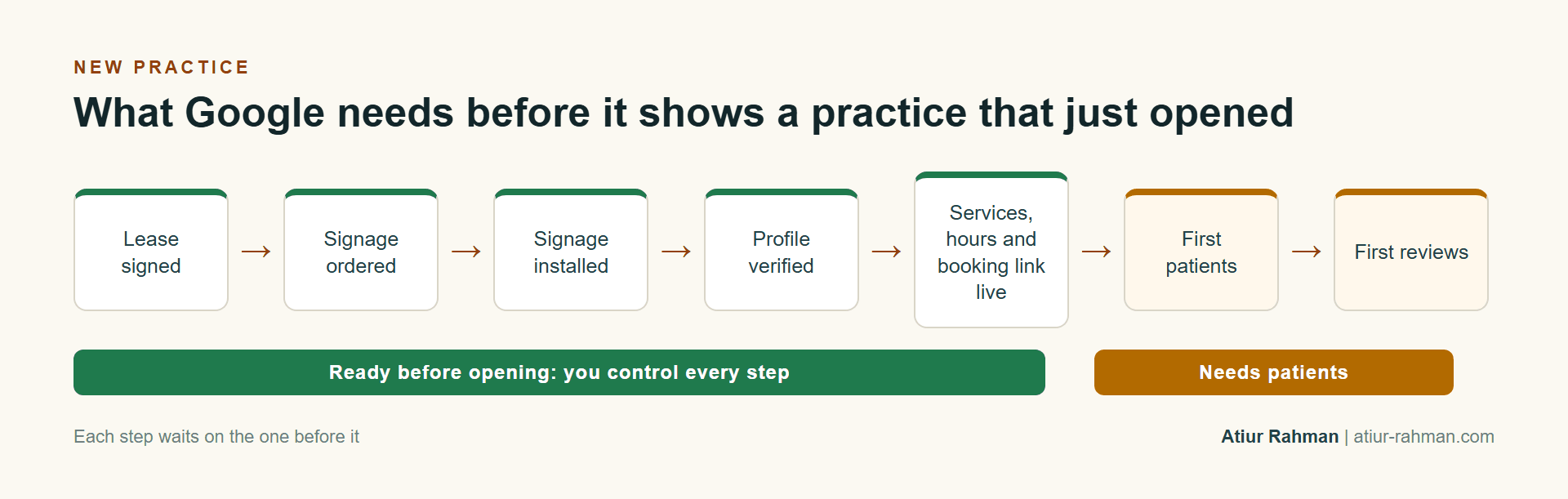
Google adds that a verified profile is more likely to appear in results. Everything on the chain above waits on that step, so the order of work follows the dependencies, not the marketing channels:
- Signage and the address come first. I tell owners to order the sign the day the lease is signed, and I lock the address format before the sign goes up.
- The profile lives on an account the practice owns. A personal account ties the listing to one person, and when a manager leaves, the listing leaves too.
- The address search comes before any creation. A previous tenant or a data aggregator can already hold a listing there. I claim it instead of creating a second one, because two profiles for one location cause display problems.
How Does Google Learn That Your Doctors Exist?
Google learns it from the same public records a credentialing office checks, then from the doctor’s own pages. Your job is to make every one of those sources say the same thing.
I match the name, specialty and practice address on the site and the profile to each doctor’s NPI registry entry and state licensing board record. A suite number that differs between the registry and your profile creates two versions of one doctor. A doctor who is public-facing and reachable at your address during stated hours can have a practitioner profile, using only that person’s name. Support staff can’t.
On your site, each doctor needs a page with real substance, because thin provider pages cause the indexing trouble I describe in the soft 404 guide. Add markup that ties the page to the entity. A minimal version looks like this, with placeholders in capitals:
<script type="application/ld+json">
{
  "@context": "https://schema.org",
  "@type": "Physician",
  "name": "DOCTOR FULL NAME",
  "medicalSpecialty": "SPECIALTY",
  "worksFor": {
    "@type": "MedicalClinic",
    "name": "PRACTICE NAME AS ON SIGNAGE",
    "address": "STREET ADDRESS, SUITE, CITY, STATE ZIP"
  }
}
</script>
Every value must match the page text and the registries. The structured data guide covers what to add and what to skip.
Which Searches Can a Brand-New Website Win on Day One?
A new site can win the searches where page one already holds practice websites, not hospital systems and national health portals. You find those searches by reading the results page, not by guessing at keywords.
I search the way a patient in your city would, then record who holds positions one through ten. Hospital networks, directories and national portals own most broad queries, and a site with no history doesn’t displace them. Queries that name a procedure and a place, or a specialty and a neighborhood, tend to show local practice sites in the mix. Those are your entry points.
I log each query in a sheet like this:
| Query pattern | Who holds page one | Entry point? |
|---|---|---|
| [procedure] [city] | Write it down | Yes if two or more are local practice sites |
| [specialty] accepting new patients [city] | Write it down | Same test |
| [specialty] [neighborhood] | Write it down | Same test |
The first pages follow the entry points: one service page per procedure, one location page, one page per doctor. Broad health articles come later, once the site has a track record. When Search Console data exists, real queries replace these guesses.
Where Do the First Reviews Come From When Nobody Knows You Yet?
They come from your first real patients, invited the same way as everyone else. Google’s review policy bans paid and incentivized reviews, bans reviews not based on a real experience and bans reviews from people with a conflict of interest, which includes family and employees.
So a new practice with zero reviews isn’t broken. A new practice with reviews from the owner’s friends, relatives or staff has broken Google’s rules, and the Federal Trade Commission’s 2024 rule on fake reviews adds federal exposure on top. The practice waits for patients, then runs one invitation process that works for every visit. The HIPAA review guide shows how to do that without exposing patient information, and Google’s review policy lists every limit.
Frequently Asked Questions
How soon before opening can I create the Business Profile?
As soon as your name, address and phone number are final. Creation isn’t the constraint. Verification is, and it waits on signage. I start the sign order early so verification never holds up an opening.
Does a website launched before opening rank before opening?
Google can crawl and index it early, which gives the site a head start on history. Ranking for competitive searches still depends on the competition. Treat the early launch as crawl time, not as a ranking promise.
Do I need Healthgrades, Vitals and insurer directories?
I claim the major directories and the insurers’ provider listings with the exact name, address and phone number from the signage. Patients use insurer directories to find new doctors, according to a Harmony Healthcare IT poll.
Does paying for Google Ads help my local ranking?
No. Google says there is no way to request or pay for a better local ranking. Ads run in a separate placement with a separate plan.
Can I create the profile on my personal Google account?
You can, but a practice-owned account is the safer owner, because a departure or a lost password never costs you the listing.
Opening a practice and want patients before the doors open? Book a strategy call.
References
- Google Business Profile Help, Business Profile guidelines
- Google Business Profile Help, Local ranking tips
- Google Maps contribution policy, Fake engagement rules
- Federal Trade Commission, Final rule announcement
- TechTarget, Patients and provider directories
- CMS, NPI Registry
- Schema.org, MedicalClinic and Physician