

Your clinic website is indexed. Search Console shows green. Your developer fixed the speed warnings last quarter. And the phone is not ringing any more than it was before.
If that sounds like your last audit, you are not doing anything wrong, and the audit was probably not wrong either. Technical SEO has a job, and the job has edges. Most practice owners are never told where the edges are, so they keep paying for fixes to problems their site does not have.
I audit healthcare websites for a living, and the first thing I do on any engagement is draw that line. In the next ten minutes you will learn what technical SEO controls on a medical site, what it cannot touch, and a four-question test that tells you whether your problem belongs to your developer, your content team or neither.
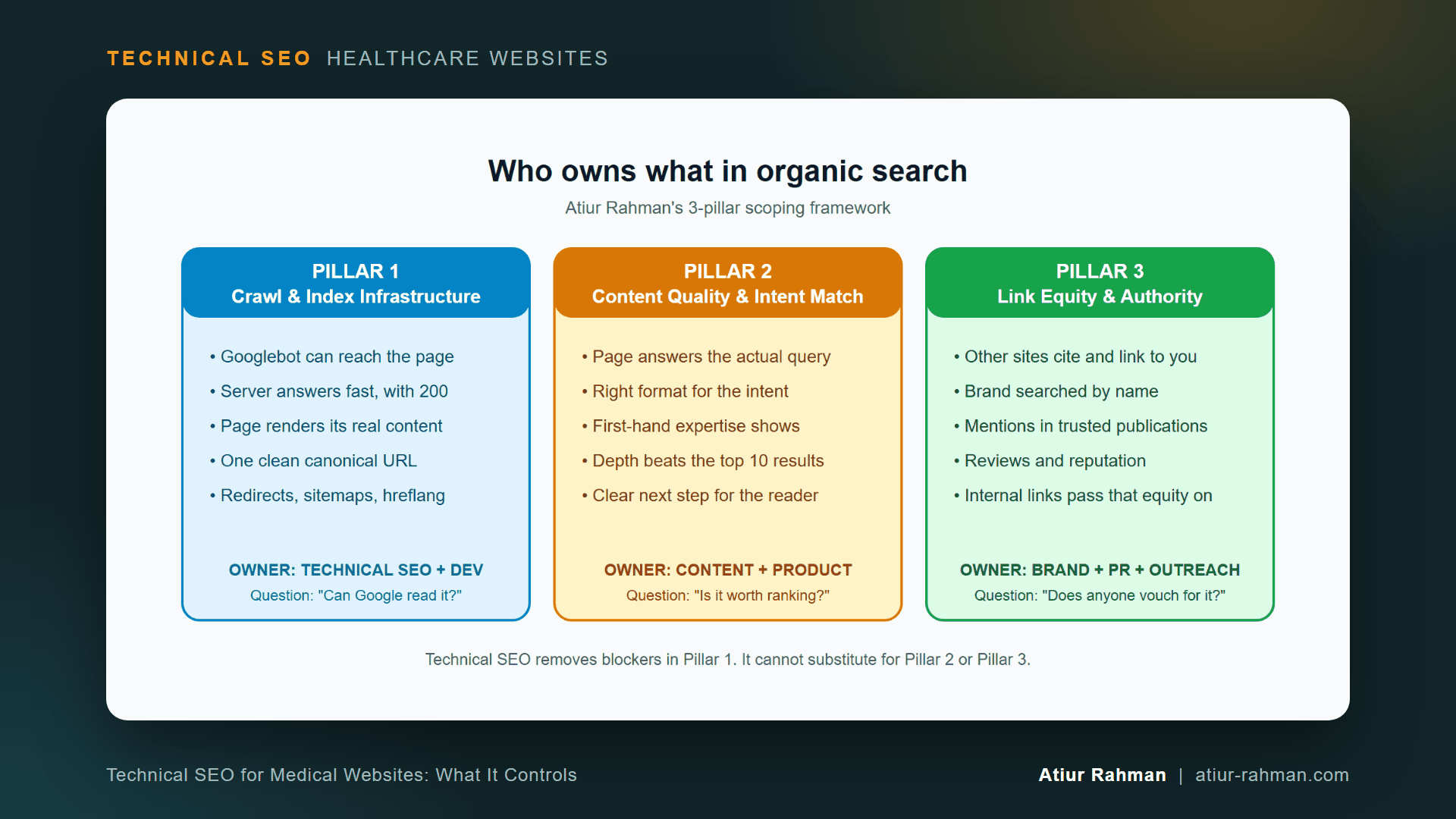
What Does Technical SEO Actually Control on a Medical Website?
Technical SEO controls whether Google can reach, render, understand and store your pages. It decides eligibility, not position.
Google describes the same sequence in its How Search Works documentation: crawling and indexing come first, and serving results comes last. I break that sequence apart in Crawling vs. Indexing vs. Ranking: Why a Blocked Clinic Page Still Shows in Google.
Think of a clinic building. Technical SEO is the unlocked front door, the working lights, the correct street address and the plumbing behind the walls. A building with all four still needs good care inside before anyone recommends it. The door gets the patient in. It does not make the visit worth the trip.
Which Five Things Fall Under Technical SEO?
Five things fall under it: access, response, rendering, consolidation and discovery. Each one has a clinic-specific failure that I see in audits.
| Control | What it decides | Typical clinic failure |
|---|---|---|
| Access | Can Googlebot fetch the URL? | A firewall update blocks Googlebot, or robots.txt disallows a service folder |
| Response | Does the server return the right status code, fast? | Doctor bio pages return 200 OK with “No bio available” and get flagged as soft 404 |
| Rendering | Is the real content in the HTML Google processes? | A booking widget or provider directory loads only through JavaScript |
| Consolidation | Does Google know which URL is the real one? | Ten location pages share near-identical text and compete as duplicates |
| Discovery | Can Google find the page through links and sitemaps? | Service pages sit three clicks deep behind a script-driven menu |
For the discovery row, Google’s crawlable links guidance states what counts as a followable link. A button that triggers JavaScript without a real href does not count.
When any of these five fails, ranking is off the table because the page never enters the contest. That is why I treat technical SEO as a floor. Fixing it removes blockers. It adds no merit.
What Does Technical SEO Not Control on a Healthcare Website?
Technical SEO does not control what your page says, whether patients and Google trust it, or who links to it. Three limits matter most for a medical practice.
Can Technical SEO Fix Content That Does Not Match What Patients Search For?
No. Intent match is a content decision. A patient who searches “knee pain after running” wants an explanation. If your page for that condition is a services menu with a phone number, Google indexes it correctly and ranks it poorly, because the page answers a different question.
I see this in the “indexed but not ranking” pattern. The URL is in Google, Search Console confirms it, and the average position sits on page four. The infrastructure is fine. The page does not fit the query.
Does Technical SEO Build Trust on a Health Website?
No, and health topics raise the stakes. Google’s helpful content guidance says trust is the most important part of E-E-A-T, and that its systems give extra weight to strong E-E-A-T on topics that affect people’s health. Trust on a clinic site comes from named, credentialed authors, physician review, accurate clinical claims and a clear editorial policy. A server setting supplies none of those.
Can Technical SEO Replace Backlinks and Reputation?
No. Other sites linking to you, local citations, patient reviews and name recognition build authority. Internal linking moves the authority you already have around your own pages. It cannot create authority from nothing, and a flawless sitemap does not close a gap against a hospital system with thousands of referring domains.
Does Technical SEO Control Whether Patients Choose You?
No. SEO places your listing in front of a patient. The patient decides based on the title, the snippet, your reviews, your insurance coverage and how fast they can book. A clean crawl does not fix a confusing booking flow.
How Do I Know If My Clinic’s Problem Is Technical or Content?
Run a four-question triage in order. Questions one and two belong to technical SEO. Questions three and four do not.
Doctors already work this way. A blood panel does not diagnose the patient. It rules systems in or out so treatment goes to the right place. This triage rules the infrastructure in or out before anyone spends money on a rewrite or a rebuild.
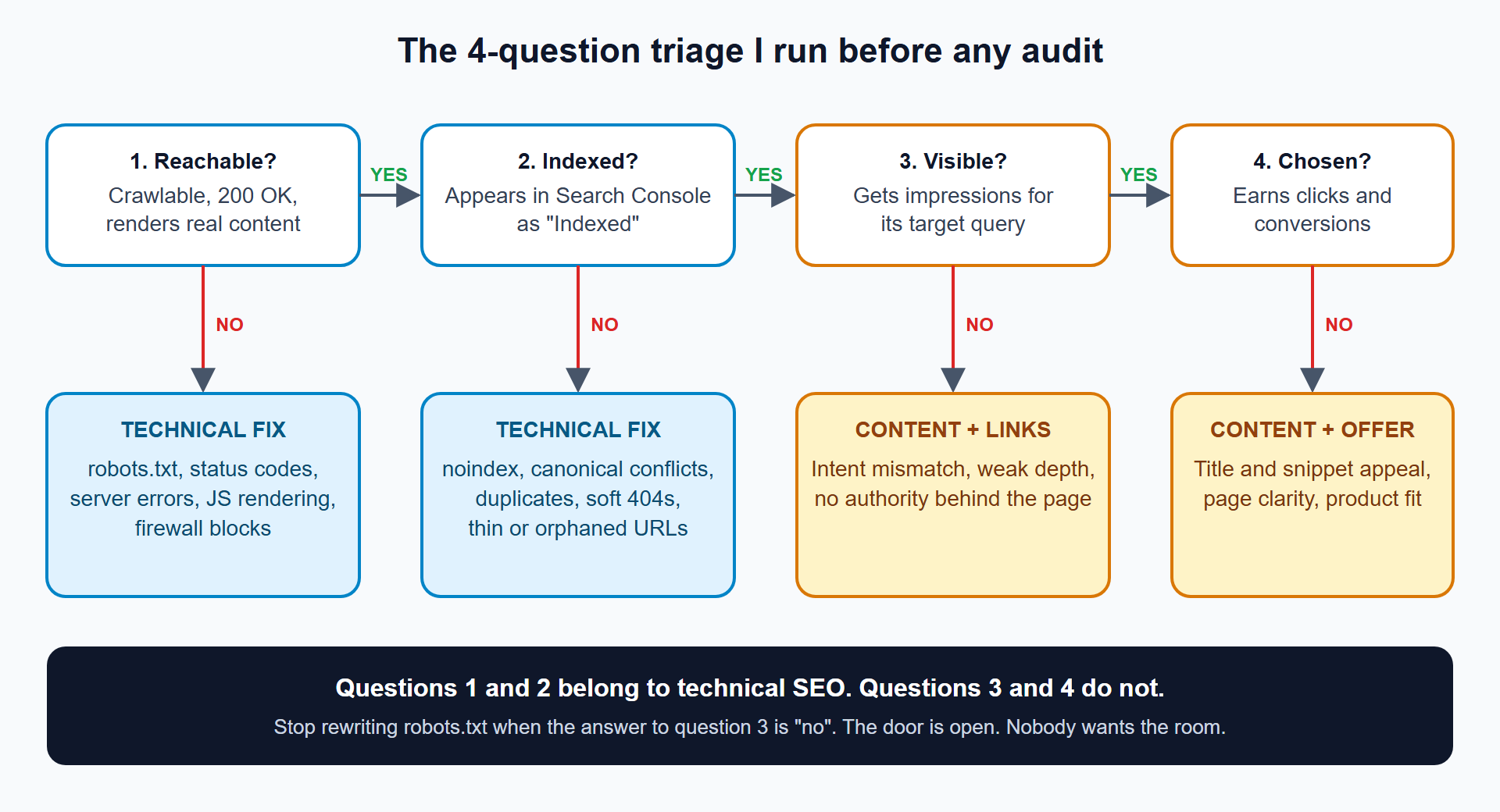
Question 1: Can Googlebot Reach the Page and Get a Clean 200?
Request the page the way Googlebot does and read the status line, the x-robots-tag header and the content type.
curl -I -A "Mozilla/5.0 (compatible; Googlebot/2.1; +http://www.google.com/bot.html)"
  https://www.yourclinic.com/services/knee-pain-treatment/
A 200 with no noindex header passes. A 403, 429 or 5xx for the Googlebot user-agent while a browser gets 200 means a firewall or rate limiter blocks Google. That is a technical failure, and a serious one.
Confirm with the URL Inspection tool in Search Console, because Google’s own fetch beats any terminal imitation.
Question 2: Is the Page Indexed?
Open Indexing → Pages in Search Console and read the exact reason on every URL that is not indexed. The Page indexing report help lists each status and what it means. “Crawled, currently not indexed” and “Discovered, currently not indexed” are different diagnoses with different owners.
Compare submitted URLs against indexed URLs. A healthy practice site indexes nearly everything it submits. A large gap points to a technical or quality problem on the missing pages.
Question 3: Does the Page Get Impressions for Its Target Query?
Open Performance → Search results, filter by the page URL and read the queries and average position. A page that is indexed, impression-rich and stuck at position 35 is not a crawl problem. Google knows the page and judges it weaker than the pages above it. That verdict belongs to content, trust and links.
Question 4: Do Impressions Turn Into Appointments?
Compare click-through rate with the position you hold. Then read the page as a patient. Does the title match the question? Does the first screen answer it? Can a patient book in two taps? Developers fix none of these with a pull request. They belong to content and the offer.
My rule for clients: when questions one and two pass and questions three and four fail, stop editing robots.txt. The door is open. The room needs work.
Who Owns the Fix: My Developer, My Marketing Team or My SEO?
Assign each symptom to one owner and one verifier. Two teams waiting on each other is the most common reason a fix sits for months.
| Symptom on a clinic website | Pillar | Primary owner | First check |
|---|---|---|---|
| New provider pages missing from Google | 1. Crawl & index | Developer + technical SEO | curl -I, URL Inspection |
| “Crawled, currently not indexed” on many pages | 1 or 2 | Both | Page quality vs. duplication |
| Booking page invisible in Google’s rendered view | 1. Crawl & index | Developer | URL Inspection rendered HTML |
| Indexed, average position 30 or worse | 2. Content | Content team | Compare the top 10 results’ format |
| Ranks, but few clicks | 2. Content | Content team | Title, snippet, first screen |
| Traffic drops right after a redesign | 1. Crawl & index | Developer + technical SEO | Redirect map, canonicals, robots.txt |
| Competitors outrank you with thinner pages | 3. Authority | Marketing + PR | Referring-domain gap, reviews |
How Do I Handle a Developer Who Wants to Fix Core Web Vitals First?
Ask one question: “If this change moves LCP from 1.9 seconds to 1.4, what changes for a page that sits at position 41?” Google’s Core Web Vitals page describes page experience as one set of signals its ranking systems reward. It does not describe a lever that lifts a weak page.
The developer’s instinct is reasonable. Speed work is concrete, measurable and inside their control. The reply that lands is not “that is wrong.” It is “your sprint is better spent on the booking flow, and I will re-check the technical numbers every month so nothing slips.”
How Do I Tell the Founder or Practice Owner Without Blaming Anyone?
Show the numbers. Put indexed ratio, response time and the average position of the target page on one slide. Say what is healthy and what is not. Earlier audits answered the question they were asked. The next question, whether the page deserves to rank, needs a different team.
What Do I Do This Week?
Run the four questions on your most valuable service page. It takes about 30 minutes.
- ☐
curl -Ithe URL with a Googlebot user-agent and confirm200and nonoindex. - ☐ Run URL Inspection and read the index verdict.
- ☐ Filter Performance by the URL and note the average position for its main query.
- ☐ Search the main query yourself. List the formats of the top three results and compare yours.
- ☐ Assign the failing question to its owner, with a date.
Reusable asset: the symptom-to-owner table above works as a one-page scope matrix. Copy it into your next kickoff document.
Related reads in this hub:
Frequently Asked Questions
Does Technical SEO Alone Make a Medical Practice Rank?
No. Technical SEO makes your pages eligible. Content that matches patient searches, trust signals and links decide where they land. A clean technical base with weak content produces indexed pages that nobody sees.
How Do I Know My Clinic Website Is Indexed but Not Ranking?
Check two Search Console reports. The Page indexing report shows the page as indexed, and the Performance report shows impressions with a poor average position. That combination means Google stores the page and judges it weaker than competitors.
Are Core Web Vitals a Ranking Factor for Medical Websites?
Yes, as one of several page experience signals. Google says it aligns with what its core ranking systems seek to reward, per its Core Web Vitals documentation. Fast pages help eligible, relevant pages. They do not lift an irrelevant page.
Does Schema Markup Make My Practice Rank Higher?
No. Google’s structured data introduction describes markup as a way to become eligible for rich results, and it makes no ranking promise. Use types such as Physician and MedicalClinic to describe your practice accurately.
Do I Need a Developer for Technical SEO?
You need one for fixes, not for diagnosis. Anyone can run the four-question triage with Search Console and one terminal command. Server rules, redirects, rendering and template changes need a developer.
How Often Does a Clinic Website Need a Technical Audit?
Run one after any redesign, platform move, booking-widget change or hosting change, and read the Page indexing report once a month. Those are the moments a working site breaks quietly.
Facing unexplained indexation drops or broken booking funnels on your clinic website? Book a 30-minute technical consultation with Atiur.
Part of the Technical SEO for Healthcare Websites series. More guides are on the blog. Related case study: Telehealth platform: 88% organic traffic recovery after YMYL core update.
References
- Google Search Central, How Search Works
- Google Search Central, Creating helpful, reliable, people-first content
- Google Search Central, Core Web Vitals
- Google Search Central, Introduction to structured data
- Google Search Central, Make your links crawlable
- Google Search Console Help, URL Inspection tool
- Google Search Console Help, Page indexing report
- Schema.org, Physician and MedicalClinic