

“Doctor near me” is not a patient’s first search. It is one of their last.
By the time someone types it, they have usually searched their symptoms, read a few results and decided they need a person. A Belgian study of 963 people found that almost half usually went to the doctor after searching online, yet two-thirds weren’t reassured by what they read. The search didn’t replace the appointment. It pushed people toward one.
So the question for a practice isn’t only “how do we appear when they type our specialty?” It’s “what words did they use before that, and does our website speak any of them?” This guide starts with the words, because the vocabulary gap between patients and practice websites is the most fixable problem in patient search. I run Local SEO and content work for medical practices, and a translation table like the one below is where I begin on every site.

Which Words Do Patients Type That Your Website Never Uses?
Patients describe a problem or a procedure in everyday words, while practice websites describe it in clinical or billing words, and the gap decides which pages match the search. The fix is to write each page’s heading and first sentence in the patient’s phrase and keep the clinical term as the second name.
| What the patient types | What the practice site often says | What the page leads with |
|---|---|---|
| knee replacement | total knee arthroplasty | Knee replacement, also called total knee arthroplasty |
| heart doctor | cardiology | Heart doctor (cardiologist) |
| skin doctor | dermatology services | Skin doctor (dermatologist) |
| children’s doctor | pediatric medicine | Children’s doctor (pediatrician) |
| doctor accepting new patients | now enrolling | Accepting new patients, with the date the list was last checked |
| walk in clinic | urgent care | Walk-in care, with the hours it runs |
The table shows terminology only. It never turns a page into advice about a condition, and clinical claims on those pages stay with the physicians who review them. The point is narrower: a page that says “arthroplasty” in its heading doesn’t match someone typing “knee replacement,” however accurate the page is. Google’s own help text on local ranking starts with relevance, and relevance starts with the words matching.
Where Is Your Practice Named When the Patient Isn’t on Your Website?
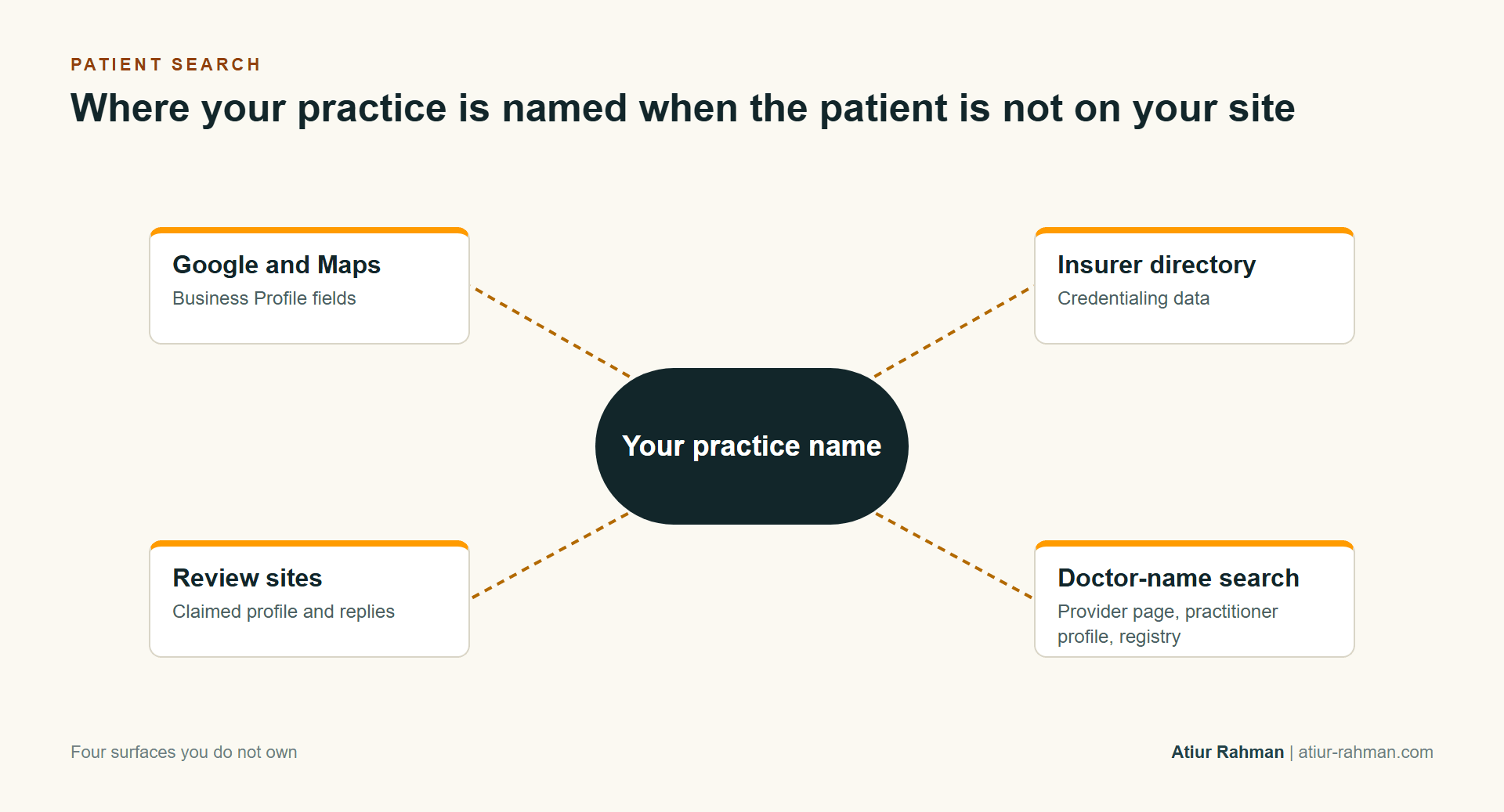
In four places you don’t own: Google’s results and Maps, the insurer’s provider directory, review sites and the search results for a doctor’s own name. Each shows different fields, and the patient forms an opinion at each before ever visiting your site.
A Harmony Healthcare IT poll reported by TechTarget found that 46% of respondents use Google search to find a new practitioner and 46% use their insurer’s provider directory. Online reviews followed at 42%, word of mouth at 32% and a referral from another provider at 29%. The poll is vendor-run and the source doesn’t state its sample size, so I read the percentages as direction, not measurement. The direction is clear: the insurer’s directory competes with Google as a front door.
Each surface has an owner and a fix.
Google and Maps
The Business Profile controls what shows. The profile setup guide covers the fields and the rules behind them.
The insurer’s directory
The practice controls it through the insurer’s credentialing and update process. An outdated address there is the mismatch I check for first.
Review sites
Claiming the profile lets the practice correct listing details and reply to reviews without exposing patient information.
The doctor’s name search
The results combine the provider page, the practitioner profile and public registry data, so all three need the same name, credentials and address.
How Do You Collect Your Patients’ Own Words?
You collect them from four sources, ordered here by effort and by how little patient information each one touches, and none of them requires reading a patient’s chart.
Search Console queries
The Performance report lists the exact queries people typed before landing on the site, including odd phrasings no keyword tool shows. It costs nothing and carries no patient information.
The front-desk log
The front desk hears the same questions repeatedly. A shared log of the questions staff answer, kept without names, produces a list of real phrases within weeks.
Call-line notes
A short, recurring review of how callers describe what they need, taken from notes the staff already write, shows the words people use when they’re not typing.
Free text on intake and booking forms
A free-text “what brings you in” field read in aggregate shows patterns. Individual entries stay inside the clinical record.
Whatever the source, the log records the phrase, how often it appears and the page it belongs on. Names, ages and conditions tied to a person never enter it. If a phrase can identify someone, it stays out.
| Phrase | Count | The page it belongs on |
|---|---|---|
| (patient’s words, no identifiers) | (service, condition or provider page) |
What Changes When the Patient Asks an AI Assistant?
The question gets longer and more specific, and the answer is assembled from pages that state a fact plainly, with a named author behind it. An assistant can’t cite a page that never states the fact.
Patients now type full questions into Google’s AI results, ChatGPT and similar tools: a symptom, a preference and a location in one sentence. Pages that win the citation lead each section with the direct answer, name the physician who wrote or reviewed it and carry markup that ties the page to the practice. The patient’s own phrasing from the wording log goes into the headings, since the question and the heading then match. The structured data guide covers the markup. I don’t promise a citation, since nobody controls what an assistant selects. I make sure the page is the kind that can be selected.
Frequently Asked Questions
Do patients still use Google to find a doctor?
Yes. In the Harmony Healthcare IT poll, 46% of respondents named Google search as a way they find a new practitioner, level with the insurer’s provider directory. Google and the insurer’s directory work as two front doors.
How much do reviews matter when a patient chooses?
They matter at the moment of choice. In the same poll, 42% of respondents used online provider reviews. A thin or negative profile sends the patient to the next name on the list, and the HIPAA rules around replies are covered in the review guide.
Does a practice need social media to be found?
Social channels add exposure, and they don’t replace the places patients check when they choose a provider. A practice with accurate listings and a clear site gets more from an hour spent there than from an hour of posting.
Do insurer directories matter for a private practice?
Yes, because patients with coverage often start there. The directory runs on the practice’s credentialing data, so address and phone changes need to go through the insurer, not only through Google.
How do I learn patients’ wording without using patient data?
Search Console queries, a nameless log of front-desk questions and aggregated intake text give real phrases without identifiers. If a phrase can identify a person, it stays out of the log.
Want your practice found in the patients’ own words? Book a strategy call.
References
- Van Riel N and colleagues, BJGP Open 2017, Dr Google study (963 respondents, recruited through social media)
- TechTarget, Patients and provider directories (Harmony Healthcare IT poll, June 2024)
- Google Business Profile Help, Local ranking tips
- Google Search Console Help, Page indexing report
- Schema.org, MedicalClinic and Physician