

An audit that lists hundreds of errors tells you less than one that lists five decisions.
That sounds backwards, because a long list feels thorough. But an administrator can’t act on four hundred warnings, and a developer can’t tell which three of them cost patient inquiries. The length is a sign the audit stopped at detection. Detection is the cheap part. Software finds errors in minutes.
What you’re buying, or building, is judgment: which problems matter, in what order, with proof. So this guide doesn’t list audit categories. Every competitor already does that, and the lists are nearly identical. It walks through the finished document, page by page, and tells you what each part must contain for you to trust it. I run diagnostic audits for medical practices, and these are the tests I hold my own reports to.
What Should the First Page of a Medical SEO Audit Say?
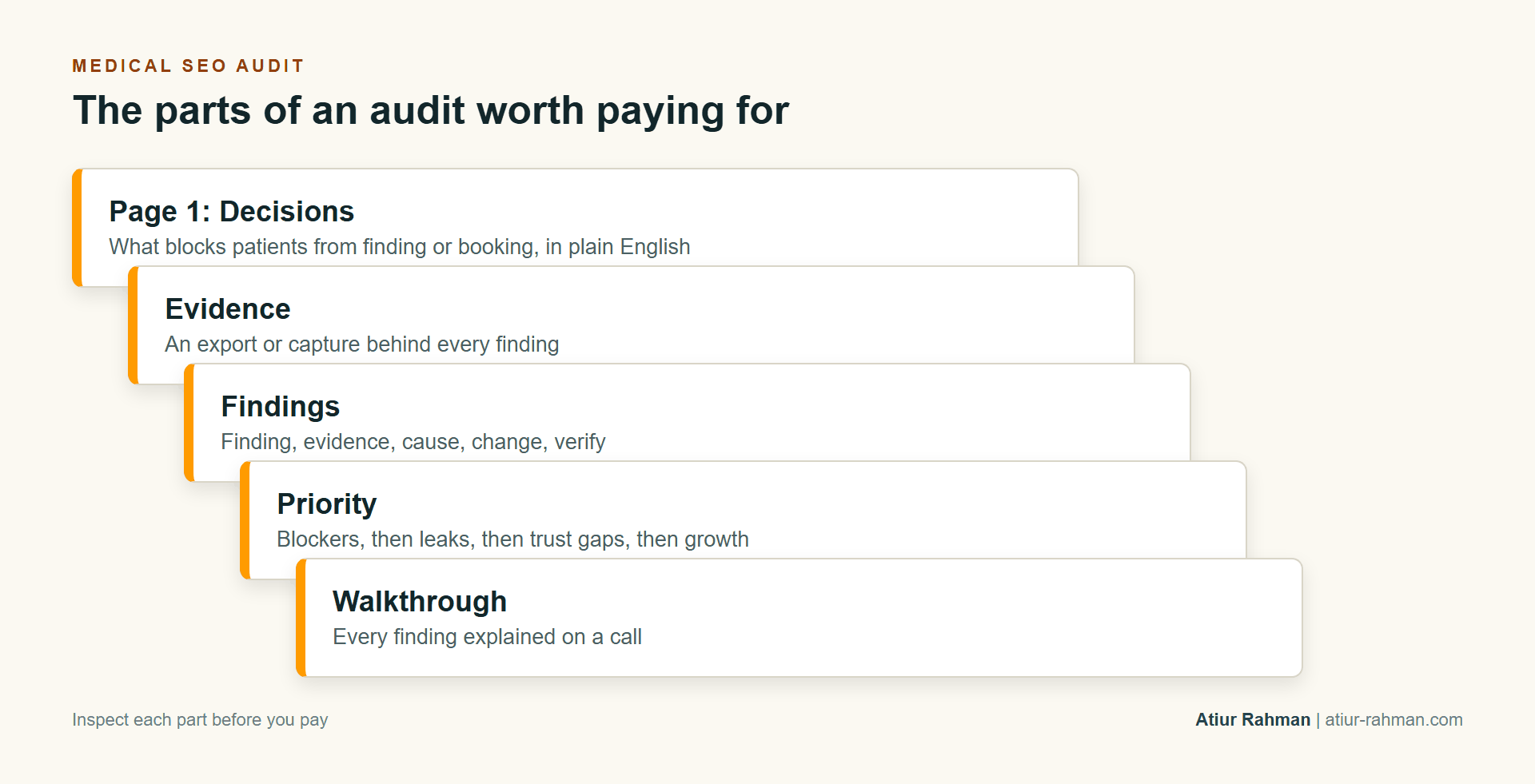
It names the few problems that cost you patient inquiries, the pages they affect and the order to fix them, in plain English that a practice administrator can read in two minutes. If the first page is a score or a count of errors, the audit hasn’t made a decision yet.
The first page answers four questions and nothing else:
- What blocks patients from finding the practice?
- What blocks patients from booking once they find it?
- Which fix comes first, and why?
- Which items need a specialist outside SEO, such as a privacy or accessibility review?
Ranking the answers needs a rule. One checklist I studied scores issues on patient impact, revenue impact, severity, scope and effort, and the idea is sound: effort breaks ties, but impact decides order. An audit that ranks by effort alone hands you the easy fixes first and leaves the expensive blocker for later.
What Evidence Should Sit Behind Every Finding?
An export or a capture that you can open yourself. A finding without an artifact is an opinion, and an audit with only opinions can’t be checked.
| Type of finding | The evidence to ask for | Where it comes from |
|---|---|---|
| Pages Google won’t index | The Page indexing report export and a URL Inspection result for sample pages | Search Console |
| Crawl and redirect problems | A crawl export with status codes and redirect chains | A site crawler |
| Slow or unstable pages | Field data per page template | PageSpeed Insights and Search Console |
| Wrong or missing markup | Validation output for each template | Google’s Rich Results Test |
| Profile and listing problems | Profile screenshots, a competitor comparison, a grid map of visibility | Business Profile and a grid tracker |
| Weak trust signals | A page list showing missing author, reviewer and update dates | Manual review |
| Booking leaks | Event counts by device | GA4 |
| Crawler behavior | A sample of bot requests by status code | Server logs |
The last row separates a diagnostic from a scan. Logs show what Googlebot did, and a tool can’t invent that. My server log guide shows how to read a sample.
How Is One Finding Written So a Developer Can Build the Fix?
In one block with five parts: what is wrong, the evidence, the cause, the change and how to verify it. A finding that skips the cause or the verification sends developers back with questions.
This is the template I use. Square brackets mark what changes from finding to finding:
FINDING    [What is wrong, one sentence, with the page type]
EVIDENCE   [Export name, row count, a sample URL, the date pulled]
CAUSE      [The template, setting or rule that produces it]
CHANGE     [The exact edit: file or setting, before and after]
VERIFY     [How to confirm: recrawl filter, report, expected result]
Read a sample of the audit you’re evaluating against that template. If the audit says “improve provider pages” with no evidence row and no change row, it describes a mood, not a finding. The structured data guide shows what a complete markup change looks like at the CHANGE line.
How Does an Audit Decide What to Fix First?
By blocking effect. Anything that stops Google from finding pages, or stops patients from booking, goes ahead of anything that improves pages that already work.
I sort findings into four bands, in this order. Blockers stop discovery: noindex tags, blocked paths, broken redirects, an unverified or suspended profile. Leaks lose patients who arrive: a form that fails on phones, a booking widget that doesn’t load, a phone number that isn’t tappable. Trust gaps weaken pages that rank: missing author and reviewer details, thin provider pages. Growth work adds new reach: new service pages, new location pages, new content. A report that opens with growth work while a blocker sits unfixed has the bands in the wrong order.
What Should You Ask the Auditor Before You Pay?
You ask for a sample finding, the evidence behind it and the format of the walkthrough, because an auditor who can’t show them is selling a scan.
Six questions sort the work quickly:
- Which findings came from a person reading the site, and which from a tool?
- Can I see one finding with its evidence and change written out?
- How do you rank findings, and who decides the order?
- Which items do you hand to a privacy or legal specialist, and which do you decide yourself?
- Does the walkthrough call cover every finding or only the top few?
- What does “done” mean for a fix, and how do you verify it?
The fourth question protects you most. Privacy, accessibility and clinical-accuracy items need qualified review, and an SEO audit that gives legal advice has overstepped.
What Can an Audit Never Do?
It can’t change your rankings. Fixes change rankings, and only when they ship. An audit can’t give legal advice either, so HIPAA, accessibility and clinical-accuracy items go to counsel and clinical reviewers.
This is also why I scope my diagnostic audits as a fixed two-week piece of work with a prioritized plan at the end, as described on the diagnostic audits page. The audit stays small and decisive, and the rest of the work is the fixing.
Frequently Asked Questions
How long does a thorough medical SEO audit take?
It depends on the size of the site and the number of locations. My diagnostic audits run as a fixed two-week scope: a technical, content and competitive diagnosis, a prioritized 90-day roadmap and a recorded walkthrough call. Larger multi-location groups take longer.
How often does a practice need an audit?
Once a year, and before any redesign, platform change or migration. An unexplained drop in impressions or calls after an update also justifies one.
Can an in-house marketing coordinator run the audit?
Yes, for profile accuracy, directory checks and form testing. Log analysis, crawl diagnosis and markup review need practice with the tools, and the findings still need someone to rank them.
Does an audit guarantee better rankings?
No. Rankings change when the fixes ship and the work behind them is in place. The audit shows what to ship first.
Which tools does an audit use?
Search Console, GA4, a site crawler, PageSpeed Insights, Google’s Rich Results Test, a grid tracker for local visibility and a log sample. The tools find evidence. The judgment turns it into a plan.
Want an audit that ends in a prioritized plan? See diagnostic audits.
References
- Google Search Central, Structured data intro
- Google Search Central, Crawl budget guide
- Google Search Console Help, Page indexing report
- Schema.org, MedicalClinic and Physician